FAQ
What is Product Climate Footprint?
The climate footprint of a product refers to its impact on climate change. It is assessed by measuring the greenhouse gases (carbon dioxide, methane, nitrous oxide, etc.) emitted throughout its lifecycle, from raw material extraction to disposal (cradle to grave), expressed in kilograms of CO2 equivalents (CO2e).
Why is understanding the climate footprint of products important?
We aim to reduce the impact of our product portfolio and provide insight for you to help you estimate the potential impact based of your purchase.
The first step to GHG reduction is measuring. With our scale, we believe we have the power to encourage our suppliers worldwide to decrease their products’ climate footprint and join us in our aim to address climate change.
How is the climate footprint of a product calculated?
To ensure consistency and accuracy, we have established requirements and aligned with manufacturers or suppliers:
- 1. Scope of assessment: the impact of the product throughout each stage of its life cycle, including raw material extraction, production, distribution, use, and disposal (cradle to grave)
- 2. Methodology: Adhere to standards like Product Environmental Footprint (PEF), Environmental Product Declarations (EPD), or relevant ISO standards.
- 3. Functional unit: specifies the unit of measurement that the calculation is based on.
In general, you can distinguish different data accuracy although it uses the same methodology and scope. They are as follows:
- --> Better data accuracy - Environmental Product Declaration / Product Environmental Footprint reports – are standardised, third-party verified documents that transparently present credible information about a product’s impact on the environment.
- --> Estimated data accuracy:
- Third-party validated Life Cycle Assessment (LCA) result - this result is not as standardised as EDP or PEF, however, the adopted methodology shall align with EPD, PEF or relevant ISO standards.
- Estimated Global Warming Potential (GWP) result – this result is the most general product’s climate footprint data based on generic, sectors and cross-sector factors.
The information shared by Lyreco is provided by the manufacturer or supplier OR it is based on the Global Warming Potential (GWP) calculation conducted by 3rd party service provider.
What standards are used to measure the climate footprint?
Standards such as ISO 14040/14044 for life cycle assessments and ISO 14067 used to measure and report carbon footprint of products.
Do you provide climate footprint information for all products?
As a reseller, we are actively engaging with our suppliers to obtain information on the climate footprint of their products. However, since this is a evolving topic for many of our suppliers, we anticipate that it will take a few years before we can provide climate footprint information for the majority of the products we offer.
Can I use the climate footprint data to compare different products?
In general, a comparison is only possible when the methodology and scope used to calculate the climate footprints are the same for both products. If the life cycle assessment (LCA) methodology or scope differs, the information cannot be used for direct comparisons of carbon emissions. Variations in these factors can lead to inaccurate comparisons within the same product category.
How often is the climate footprint data updated?
We update our climate footprint data whenever we receive updated information from our suppliers when there are significant changes in the production process, supply chain, or materials used.
Can we get a detailed report on the climate footprint of specific products?
Yes, we can provide detailed reports on the climate footprint of specific products. Please contact our customer support team to request this information.
Can the climate footprint information help us achieve our sustainability targets?
We aim to reduce the impact of our product portfolio and provide insights to help you estimate the potential impact of your purchases. This is an initial step to encourage our suppliers to disclose their climate footprint data. In the future, we hope to support you further in understanding the potential impact of your purchases.
Where I can find the climate footprint info in Lyreco website?
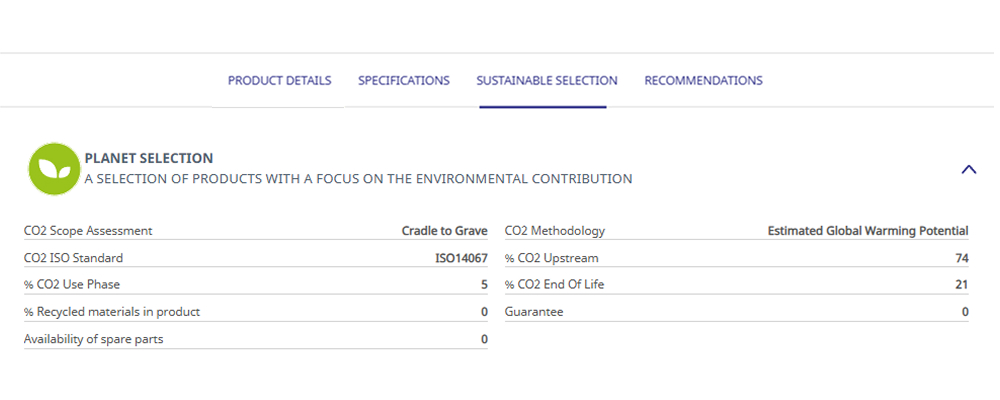
At this moment, we are still in the implementation phase of displaying climate footprint information on the Lyreco webshop, country by country. Generally, customers can find the climate footprint information on the product detail page under the “Sustainable Selection” section.




 Thailand